

Rural Odisha is closely shaped by agriculture, livestock rearing, and village-level food systems. These activities generate large volumes of organic waste in the form of cattle dung, crop residues, kitchen waste, and agro-processing by-products. At the same time, many rural households and institutions continue to face challenges related to clean cooking fuel access, reliable energy supply, and effective waste management.
Community biogas models present an approach that connects these challenges into a single, integrated system. By aggregating organic waste at the village or cluster level and converting it into biogas, communities can address energy access, sanitation, and agricultural sustainability together. While biogas technology itself is well established, its community-scale application in rural Odisha has produced mixed outcomes, influenced as much by institutional and social factors as by technical design.
Rural Waste and Energy Context in Odisha
Odisha has a predominantly rural population with strong dependence on agriculture and allied activities. Publicly available livestock census data confirms that the state has a substantial cattle population, resulting in steady availability of feedstock across most districts. Paddy cultivation, horticulture, and small-scale food processing further contribute to organic waste generation throughout the year.
Despite this availability, much of the organic waste remains underutilized. Cattle dung is often applied directly to fields or dried for traditional fuel use, while food waste from households and institutions is frequently disposed of informally. At the same time, a significant number of rural households continue to rely on firewood / solid fuels for cooking, creating health and environmental concerns.
This combination of available feedstock and unmet clean energy needs makes rural Odisha a relevant context for community-level biogas systems, provided they are designed around local realities.
Understanding Community Biogas Models
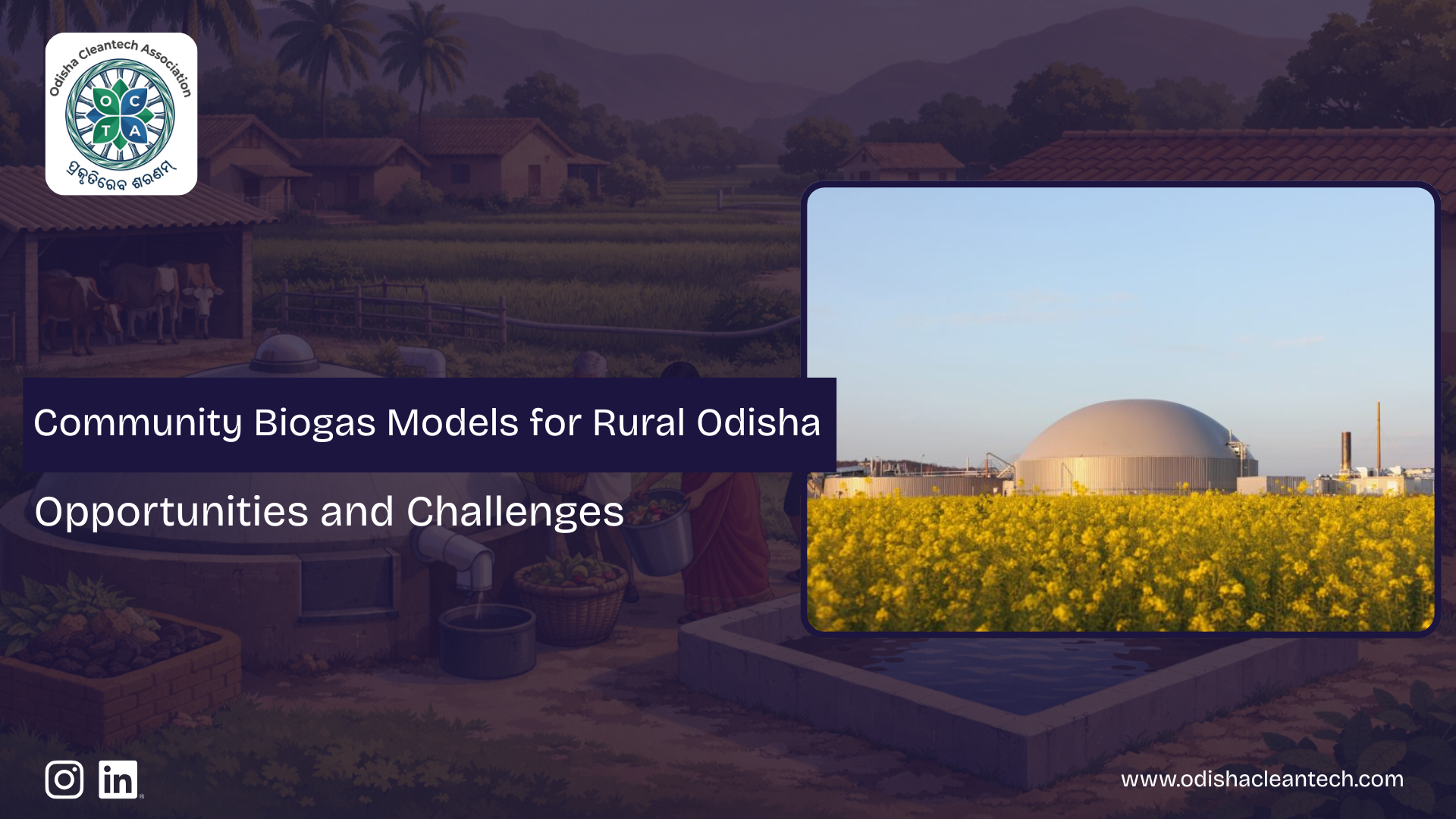
Community biogas models involve shared anaerobic digestion facilities that process organic waste collected from multiple households, farms, or institutions. Unlike individual household biogas plants, these systems operate at a village or cluster scale, supplying energy to multiple users.
Biogas generated can be used for community kitchens, piped cooking gas connections, electricity generation for local facilities, or thermal applications such as milk chilling and food processing. The digestate produced as a by-product is typically returned to farmers as organic manure.
In rural Odisha, such models are most relevant where livestock ownership is concentrated or where institutions such as hostels, schools, ashrams, markets, or dairy clusters provide predictable waste streams.
Emerging Examples from Odisha’s Rural Landscape
Odisha has seen several small-scale but meaningful examples of community biogas deployment, often supported through government programs, NGOs, or cooperative structures.
In parts of tribal and rural districts, community biogas plants have been set up to support hostel kitchens, community dining facilities, and village institutions, reducing dependence on firewood. These projects typically rely on locally sourced cattle dung and food waste and supply gas primarily for cooking purposes.
In peri-urban rural areas around Bhubaneswar and Cuttack, cluster-level biogas systems linked to dairy operations and institutional kitchens have also been piloted. While limited in scale, these installations demonstrate that shared biogas infrastructure can function effectively when feedstock availability and energy demand are well aligned.
At the national level, ongoing promotion of decentralized and compressed biogas models has further validated the relevance of aggregation-based approaches, offering learnings that can be adapted to Odisha’s rural context.
Opportunities Presented by Community Biogas Models
- Clean and Reliable Energy Access: Community biogas systems can reduce dependence on traditional biomass fuels, improving indoor air quality and reducing the burden of fuel collection. This is particularly relevant for community kitchens, hostels, and institutions where cooking demand is concentrated and predictable.
- Improved Waste Management and Sanitation: By converting organic waste into energy, community biogas plants reduce open dumping and unmanaged decomposition. This contributes to better sanitation outcomes and lowers environmental impact at the village level.
- Agricultural and Soil Health Benefits: Digestate from biogas plants serves as organic manure, returning nutrients to agricultural fields. This supports soil health and aligns with sustainable farming practices increasingly promoted across rural Odisha.
- Local Employment and Community Ownership: Community-scale biogas systems require local operation, waste collection, and basic maintenance. When structured through cooperatives or village institutions, these models can generate local employment and strengthen community ownership and accountability.
Key Challenges in Rural Odisha
Despite clear opportunities, community biogas models face several challenges in Odisha.
Feedstock aggregation remains a primary issue. While organic waste is abundant, consistent collection from multiple households requires coordination, incentives, and clearly defined responsibilities. Seasonal variations in agricultural activity can further affect feedstock availability.
Operational sustainability is another critical challenge. Biogas plants require trained operators, routine maintenance, and monitoring. Many systems underperform after initial commissioning due to lack of long-term operational planning and skill development.
Governance plays a decisive role. Projects that lack clarity on ownership, benefit sharing, and decision-making authority often face disputes or neglect. Community consensus is essential but difficult to sustain without formal governance structures.
Financial sustainability also needs careful attention. While capital support is often available through public programs, ongoing costs must be met through user contributions or institutional budgets. Designing transparent and equitable cost-recovery mechanisms is essential for long-term viability.
Policy and Institutional Framework Considerations
Community biogas deployment in Odisha sits within broader renewable energy, rural development, sanitation, and clean cooking policy frameworks. Government programs have historically supported household and community biogas plants through capital assistance and technical guidance.
However, community-scale systems require stronger institutional coordination than household units. Alignment between rural development departments, panchayati raj institutions, agriculture agencies, and energy departments is necessary to ensure sustained operation.
Clear frameworks around ownership models, operator training, post-installation support, and performance monitoring can significantly improve outcomes.
Pathways for Scaling Community Biogas in Odisha
For community biogas to move beyond pilot projects, a shift from project-centric to system-centric planning is required.
Cluster-based approaches, where multiple villages or institutions are linked to shared facilities, can improve economies of scale. Capacity-building at the local level, including operator training and governance support, is equally important.
Integrating biogas planning with dairy cooperatives, rural livelihoods programs, and sanitation initiatives can further strengthen alignment and reduce fragmentation.
Way forward…
Community biogas models offer a context-appropriate solution for rural Odisha, addressing energy access, waste management, and agricultural sustainability through a single integrated system. Their success, however, depends less on technology and more on institutional design, community ownership, and operational discipline.
With realistic planning, strong local governance, and supportive policy frameworks, community biogas systems can evolve from isolated projects into durable rural infrastructure. The opportunity lies not in rapid replication, but in building resilient models that reflect Odisha’s social structures, agricultural practices, and long-term development priorities.