

Municipal solid waste (MSW) management has become one of the most persistent urban governance challenges across Indian cities. Rapid urbanisation, rising consumption levels, and expanding municipal boundaries have led to a steady increase in waste generation, while land availability and environmental tolerance for disposal sites continue to shrink. Odisha’s cities reflect this national trend, facing growing pressure to manage waste in a manner that is environmentally compliant, socially acceptable, and financially viable.
Within this context, energy recovery from MSW is often discussed as a pathway to reduce landfill dependence while extracting value from waste streams. However, energy recovery is not a standalone solution. Its success depends on waste composition, institutional capacity, technology selection, and integration with broader solid waste management systems.
The Municipal Solid Waste Reality in Urban India and Odisha
Publicly available national assessments consistently indicate that Indian urban centres collectively generate well over one lakh tonnes of MSW per day, with biodegradable waste forming a substantial share of the total stream. Food waste from households, markets, hotels, hostels, and institutions dominates this organic fraction, alongside recyclables and inert material.
Cities in Odisha such as Bhubaneswar, Cuttack, Rourkela, Sambalpur, Berhampur, and Balasore have expanded significantly over the past decade. Alongside population growth, commercial activity and institutional infrastructure have increased daily waste generation. While door-to-door collection coverage has improved in many municipalities, segregation at source remains inconsistent, resulting in mixed waste streams reaching processing or disposal sites.
This reality has direct implications for energy recovery. Technologies that rely on specific waste characteristics cannot perform reliably when feedstock quality fluctuates.
Why Municipal Solid Waste Is Difficult to Convert into Energy
Waste Composition and Variability
Indian municipal waste typically has:
- High moisture content due to food and organic waste
- Significant inert material such as dust, silt, and construction debris
- Seasonal variation in composition and calorific value
These characteristics complicate energy recovery. Thermal technologies require relatively dry, high-calorific waste, while biological processes require clean, source-segregated organic fractions. Mixed waste reduces efficiency, increases maintenance requirements, and raises operational costs.
Dependence on Landfills
Despite policy emphasis on processing, landfilling remains the dominant end-point for municipal waste in many cities. Existing dump sites are under increasing environmental scrutiny and face public opposition due to odour, leachate, and health concerns.
Reducing landfill dependency is therefore a key driver behind interest in energy recovery, but doing so requires reliable upstream waste management systems.
Energy Recovery Pathways from Municipal Solid Waste
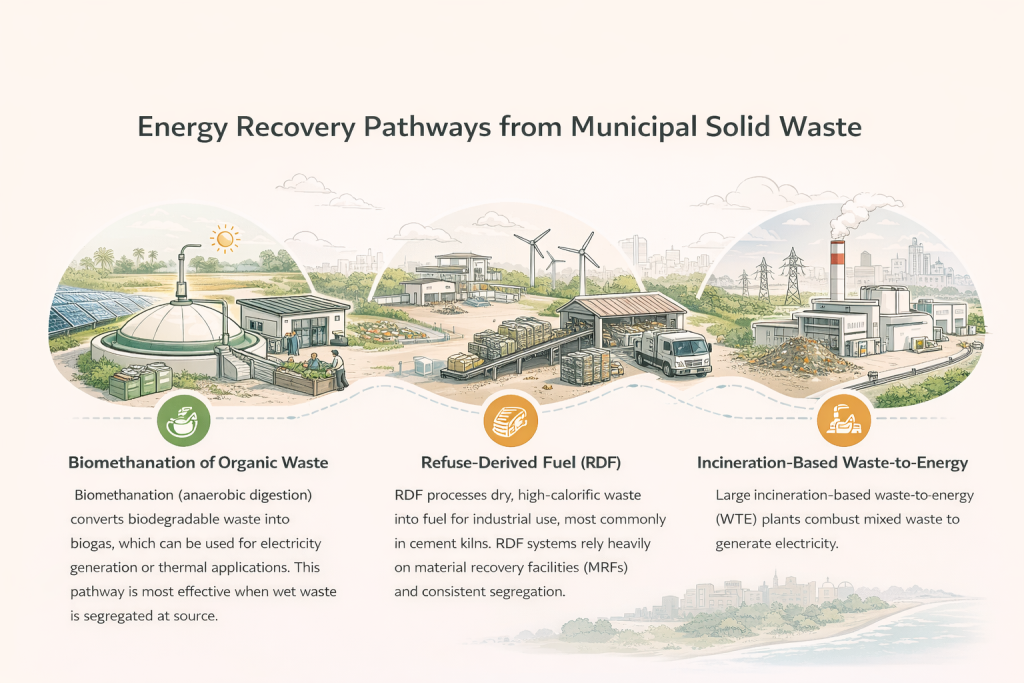
Energy recovery from MSW includes multiple approaches, each suited to different waste fractions and urban contexts.
🔹 Biomethanation of Organic Waste
Biomethanation (anaerobic digestion) converts biodegradable waste into biogas, which can be used for electricity generation or thermal applications. This pathway is most effective when wet waste is segregated at source.
In Odisha, urban local bodies have implemented small-scale biomethanation plants at markets and institutional locations, particularly in Bhubaneswar. These plants primarily focus on reducing organic waste volumes and meeting local energy needs rather than exporting electricity to the grid.
These decentralised systems show energy recovery can work when waste streams are predictable and well managed.
🔹 Refuse-Derived Fuel (RDF)
RDF processes dry, high-calorific waste into fuel for industrial use, most commonly in cement kilns. RDF systems rely heavily on material recovery facilities (MRFs) and consistent segregation.
While Odisha’s RDF ecosystem is still evolving, several Indian cities show RDF can function as part of an integrated waste management framework when recyclables and inert material are effectively removed upstream.
🔹 Incineration-Based Waste-to-Energy
Large incineration-based waste-to-energy (WTE) plants combust mixed waste to generate electricity. While deployed in some Indian metros, projects have faced challenges related to emissions control, feedstock quality, and public acceptance.
For most mid-sized cities in Odisha, waste volumes, composition, and institutional capacity make large incineration plants a complex and often unsuitable option in the near term.
Opportunities Created by Energy Recovery
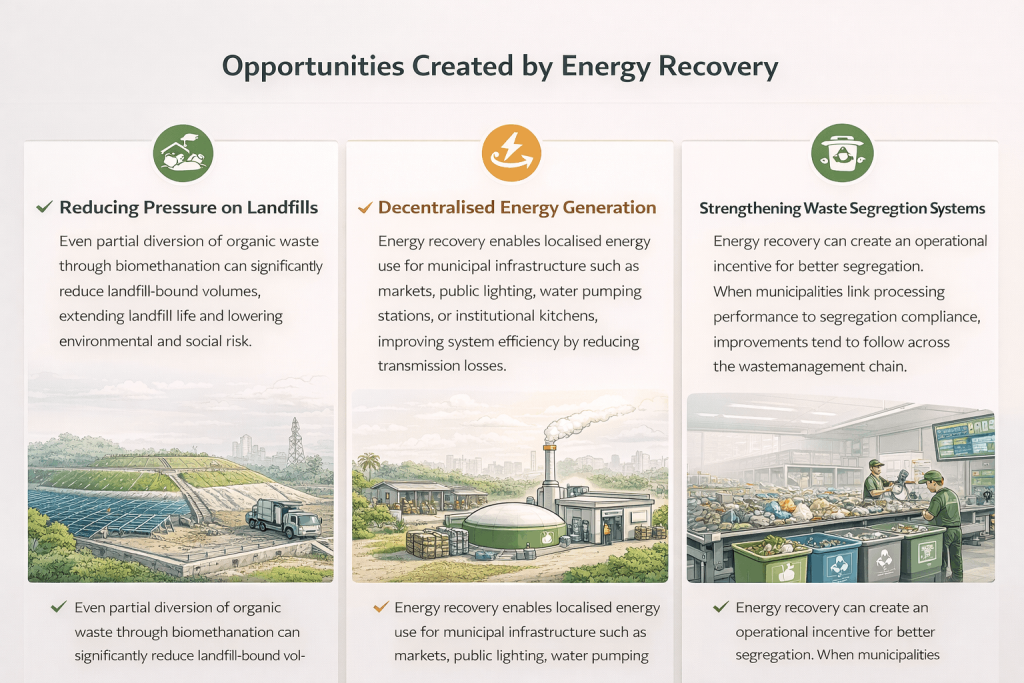
🔹 Reducing Pressure on Landfills: Even partial diversion of organic waste through biomethanation can significantly reduce landfill-bound volumes, extending landfill life and lowering environmental and social risk.
🔹 Decentralised Energy Generation: Energy recovery enables localised energy use for municipal infrastructure such as markets, public lighting, water pumping stations, or institutional kitchens, improving system efficiency by reducing transmission losses.
🔹 Strengthening Waste Segregation Systems: Energy recovery can create an operational incentive for better segregation. When municipalities link processing performance to segregation compliance, improvements tend to follow across the waste management chain.
Key Challenges Limiting Energy Recovery
🔹 Inconsistent Source Segregation: Without reliable segregation, energy recovery systems underperform. Mixed waste lowers biogas yield, complicates RDF production, and increases downtime and maintenance costs.
🔹 Institutional and Operational Capacity: Facilities require continuous feedstock management, skilled operators, and performance monitoring. Many urban local bodies face constraints in technical expertise and long-term operational oversight.
🔹 Financial Viability: WTE projects need capital investment and long-term operational commitments. If waste supply, energy utilisation, or operating costs are misjudged, projects can struggle after commissioning.
🔹 Public Perception and Environmental Compliance: Concerns around emissions, odour, and plant siting can trigger public resistance, especially for thermal technologies. Transparent communication and strict environmental monitoring are essential.
Policy and Governance Frameworks
MSW management and energy recovery sit at the intersection of urban development, environmental regulation, and renewable energy policy. National frameworks emphasise a waste hierarchy: prioritising reduction, reuse, and recycling before energy recovery.
In Odisha, authorities increasingly position energy recovery as a supporting component within integrated solid waste management systems rather than a primary disposal solution. Clear responsibilities for waste ownership, tipping fees, energy use, and compliance are critical.
Integrating Energy Recovery into Urban Planning
Energy recovery must be embedded into city-level planning. Right-sized, decentralised systems aligned with waste availability and municipal capacity typically perform better than large centralised facilities.
Cluster-based approaches serving multiple markets or wards can improve economies of scale while maintaining operational control and accountability.
Way forward…
MSW is a growing challenge for Odisha’s cities, but it also offers opportunities for energy recovery when managed appropriately. Energy recovery should not substitute for waste reduction or recycling, but act as a complementary tool within an integrated framework.
With consistent segregation, realistic technology choices, and strong governance, energy recovery can contribute to landfill reduction, local energy supply, and improved urban sustainability. The path forward is not rapid deployment, but building systems aligned with urban scale, waste characteristics, and long-term operational realities.