

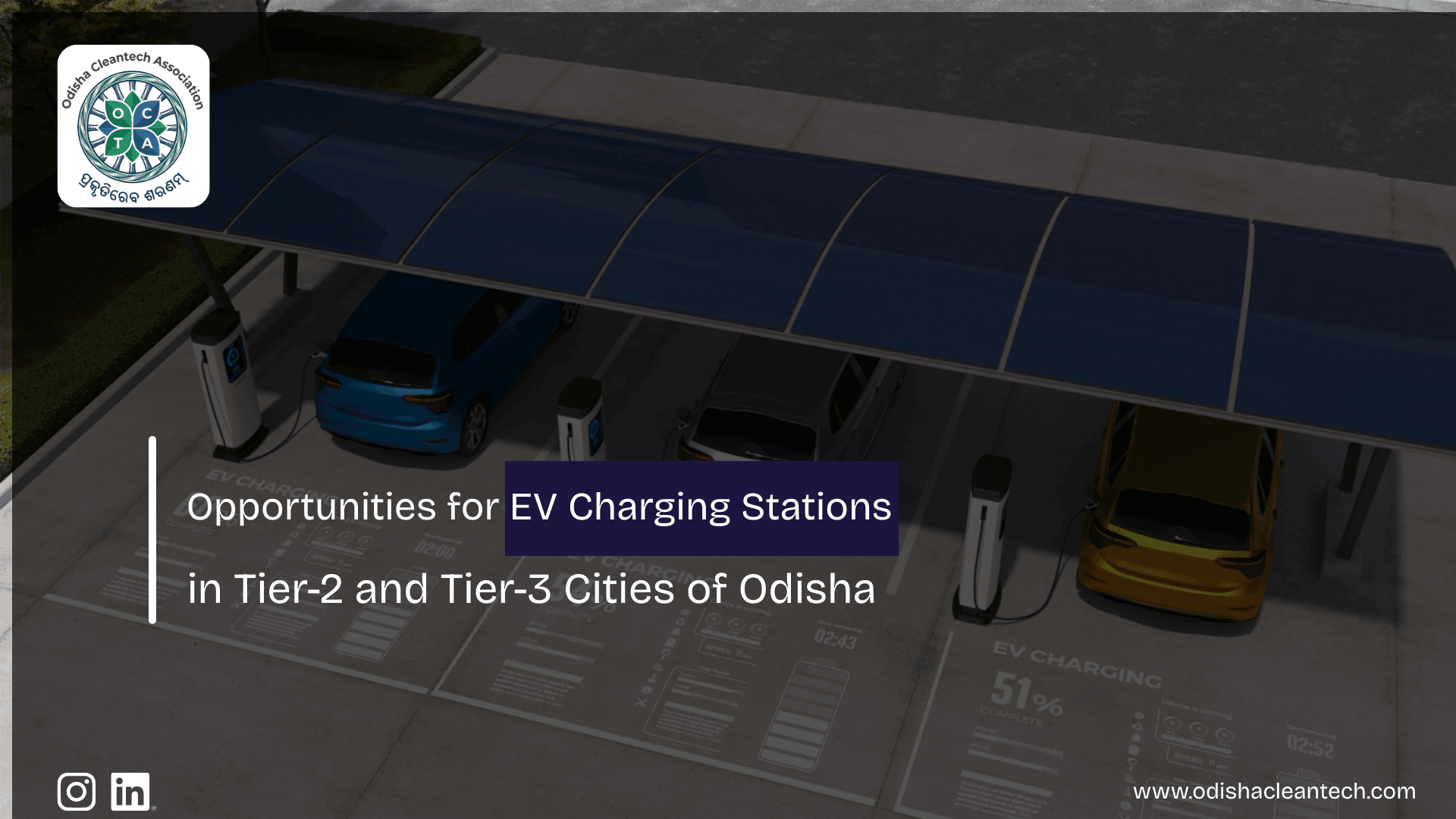
Electric mobility in Odisha is gradually expanding beyond the capital region and major urban centres. While Bhubaneswar and Cuttack have been the early focus of EV deployment and charging infrastructure, the next phase of growth is increasingly expected to come from Tier-2 and Tier-3 cities. These smaller urban centres play a critical role in Odisha’s transport ecosystem, supporting regional trade, shared mobility, government services, and inter-district travel.
For EV charging infrastructure, Tier-2 and Tier-3 cities present a distinct opportunity profile. Demand patterns, vehicle mix, land availability, and grid conditions differ significantly from larger cities, requiring charging strategies that are locally adapted, not copied from metro-centric models.
EV Adoption Trends Beyond Major Cities
Publicly available state and central government disclosures indicate Odisha has seen steady growth in EV registrations, with electric two-wheelers (E2W) and three-wheelers (E3W) forming the largest share. Importantly, a meaningful portion of these vehicles are registered outside the capital region, reflecting adoption in district headquarters and smaller towns.
Cities such as Rourkela, Sambalpur, Berhampur, Jharsuguda, Angul, Balasore, Baripada, Jeypore, and Keonjhar serve as commercial and administrative hubs for surrounding rural areas. Daily mobility is dominated by short-distance commuting, shared transport, and small commercial activity. This creates charging demand that is frequent, predictable, and closely tied to livelihoods.
While public charging stations exist in several locations, coverage remains uneven and often insufficient to meet local usage patterns reliably.
Why Tier-2 and Tier-3 Cities Offer a Distinct Opportunity
➡️ A Different Vehicle Mix: Unlike metros where private electric cars drive much of the narrative, smaller cities are primarily shaped by E2W, E3W, and fleet vehicles. These vehicles charge more frequently but operate within limited geographic areas.
So the charging focus shifts from ultra-fast to accessible, reliable, well-distributed charging that minimises downtime during working hours.
➡️ Predictable Daily Mobility: Routes for shared autos, delivery vehicles, and local commuters are largely fixed. This predictability allows charging to be planned around demand centres such as markets, transport hubs, and institutional zones.
➡️ Relatively Easier Land Access: Smaller cities often provide more flexibility for charger locations, especially near bus stands, municipal markets, district offices, and fuel stations. But grid connectivity and capacity remain the make-or-break constraint.
Key Charging Use Cases in Smaller Cities
Shared Mobility and E-Rickshaw Charging
E-rickshaws and electric autos form the backbone of last-mile transport in many Odisha towns, clustering around railway stations, bus terminals, markets, hospitals, and educational institutions.
➡️ Charging stations for this segment benefit from:
- Multiple low-capacity points (more plugs, less power per plug)
- High uptime over high charging speed
- Simple access + queue management
Dedicated e-rickshaw charging hubs can reach strong utilisation quickly if aligned with existing stands and routes.
➡️ Fleet and Depot-Based Charging
Fleet charging is the most stable demand segment in Tier-2 and Tier-3 cities. Municipal vehicles, government fleets, e-buses, logistics vehicles, and corporate cars often operate from fixed depots.
Cities like Sambalpur, Rourkela, and Berhampur already host electric buses or pilot fleet electrification programs supported by depot charging. For operators, fleet-anchored sites reduce demand uncertainty and simplify operations.
➡️ Highway and Inter-District Corridors
Tier-2 and Tier-3 cities are linked by state highways and regional corridors carrying goods and passengers. Chargers at fuel stations, highway eateries, and transport nagars can support inter-city movement.
Here, moderate-capacity DC fast chargers can serve taxis, deliveries, and private cars without overbuilding capacity.
➡️ Existing Signals from Odisha’s Smaller Cities
Public charging installations in Sambalpur, Rourkela, and Berhampur have appeared at practical locations such as fuel stations, institutional campuses, and transport-linked areas. These are signals of preferred site typologies, not yet full coverage.
Policy intent also shows momentum: official statements and documents have highlighted expansion beyond major cities, signalling that statewide coverage is necessary for sustained EV adoption.
Challenges That Need to Be Addressed
🔹 Distribution Grid Readiness: The biggest constraint is distribution-level grid capacity. Many sites will need transformer upgrades, feeder strengthening, or load reconfiguration before chargers can be energised.
Without proactive coordination between utilities and operators, chargers risk being installed but underpowered or delayed.
🔹 Utilisation Risk: Lower EV density than metros means utilisation may be modest initially. Deployment must be right-sized and phased to avoid stranded assets.
🔹 Operational Reliability” In smaller towns, downtime kills trust faster. Limited technical support and slow maintenance response can quickly reduce user confidence in public charging.
🔹 Planning Framework for Scalable Deployment: A sustainable charging strategy for Tier-2 and Tier-3 Odisha should focus on:
- AC-heavy neighbourhood charging for E2W/E3W
- Depot-based charging as the utilisation anchor
- Selective DC fast charging on corridors and high-turnover sites
- City-level grid planning to prioritise capacity upgrades
The key shift is network thinking, not isolated chargers.
Role of Local Institutions and Municipal Bodies
Urban local bodies, transport authorities, and district administrations are critical enablers through:
- Land access
- Streamlined permissions
- Alignment with city mobility plans
Partnership models (public agencies provide sites, private operators build and operate) fit smaller cities where municipal resources are limited.
Way forward…
Tier-2 and Tier-3 cities are the next frontier for EV charging in Odisha. The opportunity lies not in replicating metro-style networks, but in designing systems around local mobility, vehicle mix, and grid realities.
With right-sized infrastructure, fleet-anchored demand, and coordinated planning, charging in smaller cities can become reliable everyday infrastructure rather than speculative investment. The winners will be those who build for uptime, placement, and grid readiness first.